NOT FINANCIAL ADVICE: The content on this webpage represents personal research and opinion for informational and educational purposes only. I am not a financial advisor, and nothing here constitutes professional investment, legal, or tax advice. Do your own research before deploying capital.
Update: September 2026
Strategic Validation: The "Twin-Engine" Playbook Becomes Corporate Reality
On June 29, when Bitcoin was consolidating near $60,000 and Strategy’s flagship preferred tranche (STRC) was languishing at a steep 25% discount (~$75), the conventional playbook called for passive defense. The common narrative held that holding a 14-month cash buffer was sufficient.
The structural blueprint outlined here argued the opposite: sitting passively on a fixed cash runway in a reflexive market leaves the capital stack vulnerable to predatory short sellers. Instead, Strategy needed an unassailable offensive posture—a "Twin-Engine" strategy deploying tactical asset sales to simultaneously buy back deeply discounted STRC liabilities and pad the fiat reserve into a multi-year fortress.
Looking at corporate disclosures and capital allocations through late August and early September, that theoretical blueprint is now corporate reality.
The Summer Defense: Capturing the Liability Spread
During the July and early August market chop, management recognized the exact structural anomaly identified in our June analysis. Rather than allowing discounted preferred shares to weigh down enterprise value, Strategy executed tactical sales near the $60,000 Bitcoin mark to service distributions, fortify USD reserves, and aggressively retire STRC shares at open-market discounts.
Retiring obligations below their $100 par value locks in an immediate, risk-free gain on corporate liabilities while permanently reducing future cash burn. With the variable distribution on STRC adjusting upward to 12.00% for September 2026, every preferred share retired at a discount extinguishes a massive double-digit carry cost from the balance sheet.
The ATM Reopening and the "Runway Peg" in Action
The June blueprint argued that once the discount began to close and the balance sheet stabilized, the At-The-Market (ATM) window would blow back open. Crucially, future ATM issuances could no longer simply sweep 100% of proceeds into spot Bitcoin. To make the capital stack permanent and self-funding, new emissions required an automated governor: a Runway Peg splitting capital between asset accumulation and balance-sheet immunization.
Between August 24 and August 30, Strategy officially reopened the ATM, raising $602.8 million. The resulting capital allocation mirrored the Runway Peg framework:
- $369.7 million (61%) directed to resume spot Bitcoin accumulation (securing 4,603 BTC at an average price of $80,318).
- $151.8 million (25%) deployed directly to repurchase STRC preferred equity.
- $50.7 million (8%) earmarked to fund upcoming STRC dividend obligations.
- $30.0 million (5%) swept directly into the corporate USD cash reserve.
By refusing to run a pure 100% asset-accumulation model, Strategy demonstrated that preferred equity cannot simply be treated as leverage—it must be actively managed as an integrated capital vehicle.
The Contagion Effect: STRD’s 55% Reflexive Surge
The most compelling proof of this structural dynamic lies in the performance of STRD.
In the June 29 outlook, we modeled that aggressively fortifying the base of the capital stack and eliminating the vulnerability on STRC would trigger "immediate short-covering contagion across the entire capital stack, providing a massive, reflexive lift to both STRC and STRD."
| Metric |
June 26, 2026 |
September 2026 |
Net Change |
| STRD Market Price |
$49.00 (52-Week Low) |
~$75.90 |
+54.9% |
| Direct Strategy Buyback Allocation |
$0 |
$0 |
None |
On June 26, STRD capitulated to an all-time trough of $49.00. Over the ensuing two months, STRD ripped upward to trade near $75.90—a violent ~55% rally off the bottom.
Strategy did not deploy a single dollar of corporate capital to repurchase STRD shares. The entire $151.8 million buyback program was concentrated squarely on STRC. STRD’s violent re-pricing was pure structural contagion. Once the market realized the company was actively backstopping its liabilities, building cash reserves, and rendering the dividend engine un-killable, predatory short positions across all tranches collapsed. The entire capital stack re-rated in sympathy without requiring corporate dilution to force it.
Strategy Inc. has fundamentally transitioned from an asset accumulator into an active, self-correcting financial sovereign. By weaponizing market mispricings, pairing asset growth with debt retirement, and mechanically reinforcing its cash defenses, management broke the bear cycle. The fortress runway is operational, the reflexive flywheel is spinning, and the playbook is validated.
Strategic Blueprint: June 29, 2026
Strategic Alpha: Engineering the 30-Month Fortress Runway for Strategy Preferred Equity
In the world of corporate architecture, a 14-month cash runway is a solid defense. But in a highly volatile, reflexive environment heavily targeted by short sellers, a solid defense isn't enough. To permanently break the bear narrative, immunize the balance sheet against a multi-year crypto winter, and force a violent structural repricing of our preferred equity, Strategy must shift to an unassailable offensive posture.
By exploiting current market values—with Bitcoin stable near $60,000 and our flagship preferred tranche (STRC) trading at a deep 25% discount (~$75)—management has a historic window to engineer an ironclad, 30-month fortress runway explicitly earmarked only for dividend payments.
I. The Ideological Paradox — Cash as a Necessary Weapon
To a strict Bitcoin purist or maximalist, holding a multi-billion dollar pile of fiat cash grinds against core principles. Fiat is a melting ice cube, an asset mathematically guaranteed to lose purchasing power over time. However, there is a profound structural difference between an individual accumulating long-term wealth and a systemic corporate architecture managing a complex capital stack. Strategy is a public corporate entity that issues preferred equity denominated in USD ($100 par value) and guarantees distributions that must be delivered to brokerage accounts in USD cash.
The reality is that the vast majority of buyers in the STRx suite are purchasing these instruments specifically for their high-yield cash flow, not as pure Bitcoin maxis. They are income-focused allocators. To scale a treasury that commands a significant portion of the global Bitcoin supply, Strategy must build a functional bridge to this traditional institutional income world.
In this context, holding a massive fiat runway isn't a long-term store of value; it is an operational option premium that buys time. That fiat buffer acts as a shield, ensuring Strategy is never forced to liquidate its core digital treasury during a cyclical market capitulation just to meet its cash obligations. It satisfies the legacy financial system so Strategy can keep its hands off the Bitcoin.
II. The Baseline Math
Currently, Strategy’s capital stack requires an annualized preferred distribution run-rate of roughly $1.2 billion, driven almost entirely by the massive $10.49 billion notional footprint of STRC.
- The Current State: A $1.4 billion USD cash reserve divided by a $1.2 billion annual burn equals a 14-month runway.
- The 30-Month Target: To achieve a 30-month (2.5-year) runway at the current burn rate without altering the capital stack, Strategy would need a staggering $3.0 billion in cold hard cash.
Trying to raise an additional $1.6 billion in fiat by simply selling Bitcoin at $60,000 would require liquidating roughly 26,666 BTC. While the global market could easily absorb this volume via institutional OTC desks, doing so at a steep discount to our $75,651 corporate cost basis would represent an unnecessary destruction of net asset value. Instead, we can use the market’s mispricing of STRC as a structural cheat code to radically lower the cost of our safety wall.
III. The Twin-Engine Playbook (STRC Buyback + Cash Fortification)
Rather than just stacking raw fiat, the optimal strategy splits a targeted allocation of Bitcoin sales down the middle: 50% deployed to aggressively buy back discounted STRC liabilities, and 50% deployed directly to the USD dividend reserve. By taking advantage of the current ~$75 trading price, Strategy can capture a risk-free 25% gain on its own obligations, retiring $100 of face-value liability for every $75 spent.
1. The STRC Liability Retirement Engine: Strategy authorizes a tactical liquidation of 10,000 BTC at $60,000, generating $600 million in cash. This entire $600 million is deployed into the open market to buy back STRC at $75. As a result, Strategy successfully retires $800 million of permanent par-value obligations. Because STRC carries an 11.5% variable dividend, erasing $800 million in face-value liabilities permanently extinguishes $92 million in annual dividend obligations. The total corporate dividend burn rate instantly drops from $1.200 billion down to $1.108 billion per year.
2. The Pure Cash Buffer Engine: Simultaneously, Strategy authorizes a matching liquidation of 10,000 BTC at $60,000, generating another $600 million in cash. This entire $600 million is funneled directly into the USD Cash Reserve, earmarked exclusively for preferred distributions. The total cash buffer grows from $1.4 billion to $2.0 billion.
The Cross-Over Masterpiece
Let’s look at how the math beautifully intersects to expand our timeline footprint:
- New Cash Reserve: $2.0 Billion
- New Annual Dividend Burn: $1.108 Billion
- Total Funded Runway: $2.0B / $1.108B = 1.805 Years ≈ 21.6 Months
Percentage of Treasury Liquidated for 21.6-Month Milestone Extension:
2.36% of Treasury (20,000 BTC)
By liquidating just 20,000 BTC (a mere 2.36% of our total treasury), Strategy pushes its absolute survival timeline from 14 months to nearly 22 months while structurally shrinking the company's ongoing cash overhead. To fully scale this matrix to a clean, unyielding 30-month wall, the total combined allocation requires a liquidation of 31,500 BTC. Spreading this transaction over a standard 10-day algorithmic institutional execution window protects global crypto markets from localized volatility while permanently immunizing Strategy against any multi-year macro collapse.
IV. The Future ATM Playbook—Maintaining the "30-Month Constant"
Executing this twin-engine play does more than just buy time; it completely alters market psychology. By stepping into the public exchange as the "buyer of last resort," Strategy forces predatory short sellers to compete directly with the corporate treasury for shares. This mechanically squeezes the discount shut, forcing the trading price of STRC out of the $70s and violently resetting it back to its $100 par value.
Once STRC is restored to par, the primary At-The-Market (ATM) fundraising window is officially blown wide open again. Strategy can resume its core business model: issuing new preferred shares to institutional capital to stack more Bitcoin. However, to prevent the company from ever getting caught in a defensive posture again, the corporate architecture must implement a strict Runway Peg. Future ATM runs can no longer be used solely to acquire Bitcoin; they must be run at a mathematical rate where the 30-month runway remains a permanent, unyielding constant.
Every time Strategy runs the ATM pipeline to issue new STRC at $100, they are adding an 11.5% annual cash distribution burden to the capital stack. To keep the 30-month safety buffer perfectly pegged, every single dollar raised via the ATM must be dynamically split at emission:
- 11.5% of Proceeds: Automatically funneled into the hard USD cash reserve. This cash deposit exactly matches the 30-month funding requirement for the newly issued equity.
- 88.5% of Proceeds: Deployed to buy spot Bitcoin, expanding the underlying treasury.
By installing this automated governor, the company's runway calculation ceases to be a variable clock that investors have to nervously monitor. Whether Strategy has $10 billion or $50 billion in preferred equity outstanding, the 30-month cash defense remains an unbroken, permanent fixture of the balance sheet.
Conclusion: Absolute Sovereign Stasis
This is how Strategy transitions from a passive participant in the digital asset markets into an active, self-correcting financial sovereign. By utilizing a minor sliver of its treasury to capture current market discounts, management can wipe out expensive liabilities, pile up historical fiat reserves, and lock down a multi-year shield. Once the pricing anomaly is corrected and the Runway Peg is instituted, the reflexive flywheel is completely perfected. The bears are permanently boxed out, yield-focused investors are completely protected, and the cash flow machine becomes entirely un-killable.
Update: June 29, 2026
Pre-Market Outlook: Three Impending Catalysts Forcing Strategy Off Defense
As the trading week opens, Strategy Inc. is sitting directly at a critical structural inflection point. Following days of heavy momentum-driven short selling and retail margin liquidations across the equity tranches, the data shows that the capital stack has compressed right into a historic valuation floor. Based on the corporate framework and recent executive signals, there are three distinct scenarios likely to hit the wires early this week to disrupt the bear narrative and reposition the asset curve.

Figure 1: Michael Saylor's weekend communication highlighting the total corporate Bitcoin treasury value alongside an open-ended teaser indicating upcoming capital adjustments.
Scenario 1: Activation of the Accretive Common Stock (MSTR) Buyback Arbitrage
The continuous downward drift over the past week has pushed Strategy's common equity ($MSTR) directly into a profound value arbitrage window. The latest dashboard tracking metrics confirm that the equity's Modified Net Asset Value (mNAV) premium has collapsed to a clean 1.00x baseline multiplier.
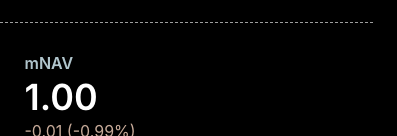
Figure 2: Real-time verification of the Modified Net Asset Value (mNAV) hitting exactly the 1.00x baseline floor.
According to the corporate treasury matrix disclosed during their last earnings cycle, hitting 1.00x mNAV or below transforms a tactical asset deployment into a massive corporate win. Management mathematically modeled this framework to show that when short sellers drive the common stock to a zero premium relative to its underlying holdings, deploying capital to buy back undervalued MSTR stock generates an automatic, riskless increase in their overall "Bitcoin-per-share" tracking matrix.
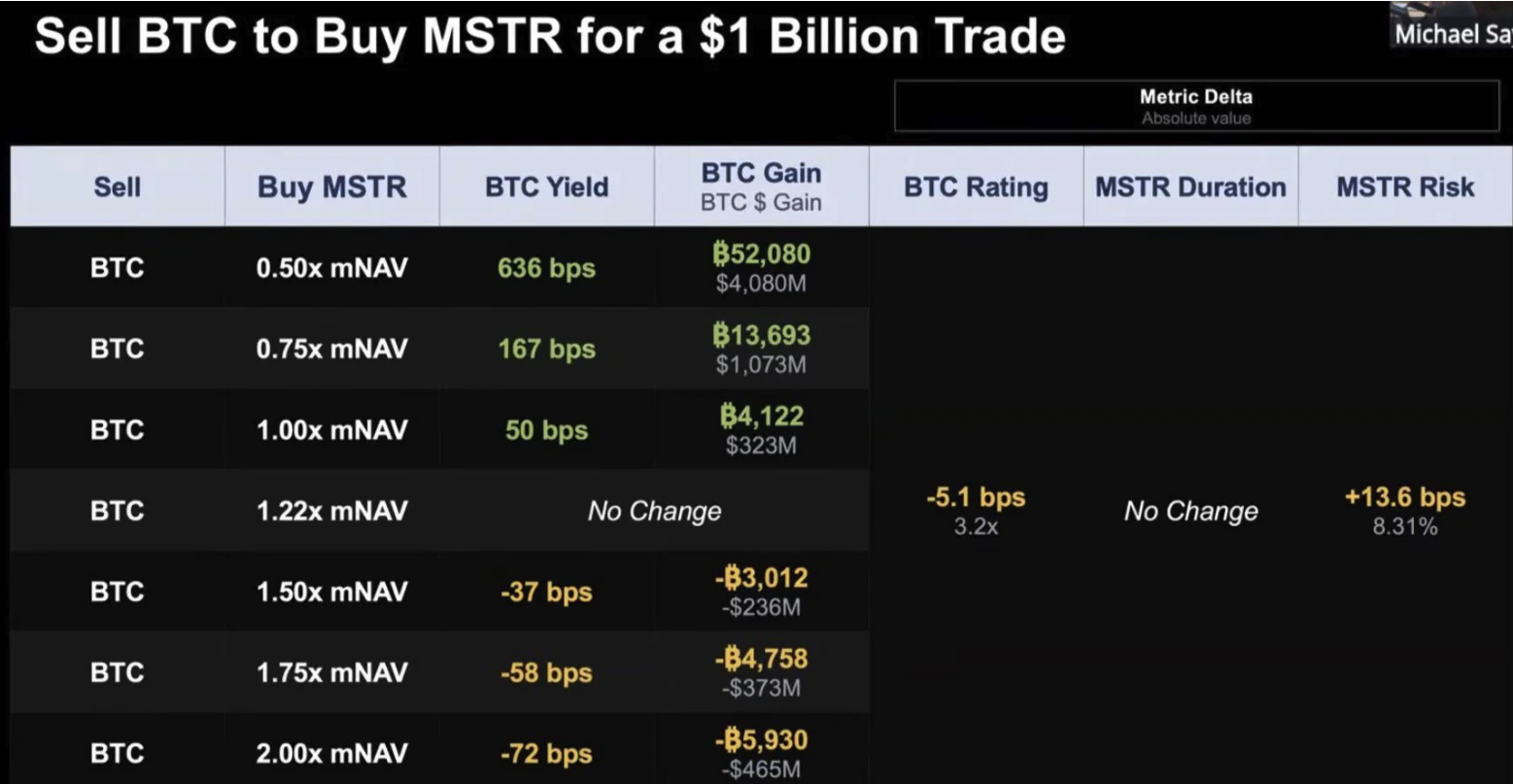
Figure 3: Strategy's corporate playbook outlining the mathematical accretion (BTC Yield) captured by liquidating tactical Bitcoin tranches to retire discounted equity at various mNAV thresholds.
Market & Sentiment Impact: While an announcement that Strategy is selling Bitcoin to fund equity buybacks will likely cause a brief knee-jerk hit to global Bitcoin sentiment as algorithmic headline-traders panic, the narrative risk is structurally limited. Once Wall Street parses the underlying math, the realization that the company is aggressively optimizing its asset-per-share ratio will turn the sentiment into an arbitrage masterpiece. Furthermore, the resulting upward explosion in the common stock will trigger immediate short-covering contagion across the entire capital stack, providing a massive, reflexive lift to both STRC and STRD.
Scenario 2: An Aggressive Weekly ATM Cash Allocation Update
Strategy maintains a transparent, highly systemic cadence for reporting its corporate liability defense buffers. In their report dated June 22, the company verified that its hard USD Cash Reserves had been successfully fortified to $1.4 billion, ensuring an ironclad 14-month dividend shield for preferred tranches without touching the digital asset treasury.
The impending early-week Form 8-K filing covering the most recent operational block window is highly likely to provide an updated confirmation of this defense. By demonstrating that they have continuously tapped their At-The-Market (ATM) capacity to pile up additional cash reserves, management can cleanly extend that 14-month runway out even further, permanently dismantling the "dwindling liquidity clock" narrative being pushed by short sellers.
Market & Sentiment Impact: This move represents the ultimate fundamental defense strategy. It completely immunizes the company against "bankruptcy timeline" FUD. The market will read this as a signal of supreme operational stability, reinforcing investor confidence and laying the groundwork for a steady recovery back to par value.
Scenario 3: Implementing an Open-Market Buyback of Flagship STRC Shares
While a common equity buyback is highly accretive, a direct open-market buyback of flagship STRC shares at current mid-$70 prices represents a masterclass in corporate liability management. From a structural finance standpoint, this move is incredibly beneficial to the company's long-term health:
- Retiring Debt at a Deep Discount: STRC carries a permanent par value obligation of $100 per share. Buying it back under $75 allows Strategy to retire its own long-term liabilities at a staggering 25%+ discount, trapping a risk-free gain directly onto the balance sheet.
- Extinguishing the Annual Cash Drain: STRC represents a massive dividend footprint of nearly $1.2 billion annually. Retiring shares immediately and permanently cancels those high-yield future payout obligations, preserving massive corporate runway.
- Re-opening the ATM Machine: Strategy's core primary fundraising relies on issuing STRC at par ($100). By stepping in as the "buyer of last resort," Strategy forces short sellers to compete for shares, mechanically squeezing the discount shut, restoring the price to $100, and unlocking their multi-billion dollar funding flywheel once again.
Market & Sentiment Impact: Sceptics might initially spin this as predatory—claiming Strategy sold STRC at $100 only to "screw over" investors by buying it back cheaper. However, institutional analysts and long-term holders will recognize that Strategy is simply clearing out panicked, over-leveraged sellers to protect the core integrity of the remaining stack. It provides vital market liquidity where a vacuum once existed.
Current rules on disclosure prevent Strategy from "telegraphing" or hinting at this move beforehand. Under strict SEC Regulation FD (Fair Disclosure) and insider trading laws, a pending buyback is Material Non-Public Information. Publicly signaling the buyback would not only invite swift regulatory penalties but would also cause front-runners to bid the price up before the company could capture the deep discount for the balance sheet. Consequently, management must maintain absolute radio silence until the official 8-K hits the wire, requiring high-conviction investors to recognize the structural opportunity independently before the announcement triggers a repricing wave.
Analysis: June 15, 2026
The Strategy Preferred Equity Thesis: Fact vs. Fiction
The recent market turbulence surrounding Strategy Inc. and its suite of Bitcoin-adjacent preferred shares has generated widespread fear, uncertainty, and doubt (FUD). However, an objective look at the underlying corporate plumbing reveals that the market is severely mispricing structural safety as existential risk. For high-conviction investors, this temporary panic creates a rare, highly asymmetric entry window.
I. The Catalysts of the Panic: Leverage, Shorts, and Strategic Missteps
To understand why the preferred tranches experienced sudden price drops, it is necessary to look past the surface headlines and analyze the specific market mechanics and executive decisions that opened the door for short sellers.
1. The Short Attack on Leveraged STRC Holders
The initial downward price action on STRC was not triggered by institutional insolvency, but by a classic forced-liquidation cascade. Because STRC was designed with a variable-rate mechanism specifically to trade near its $100 par value, many retail and institutional income investors viewed it as a low-volatility, bond-like asset. Consequently, a massive amount of hidden leverage was built up using margin accounts to multiply the 11.50% dividend yield.
Short sellers recognized this concentration of leverage. By aggressively shorting the illiquid preferred shares during a broader macro tech selloff, shorts intentionally pushed the market price down. This triggered automatic margin calls for leveraged investors. The resulting forced liquidations created an artificial, self-fulfilling selling wave that dropped STRC into the $70s, completely divorced from corporate fundamentals.
2. Saylor’s Balance Sheet Misstep
Management inadvertently amplified this vulnerability through an aggressive liability management move. Michael Saylor and CFO Andrew Kang utilized $1.5 billion of their hard USD cash reserves to prematurely buy back outstanding convertible notes at an 8% discount.
While wiping a massive liability off the books at a discount is beneficial to long-term common equity holders, using cash reserves instead of aggressively tapping the At-The-Market (ATM) equity window to fund the buyback was a distinct tactical error. It temporarily thinned Strategy’s liquidity buffer right before macro conditions soured, giving bearish analysts the "runway clock" narrative they needed to spark panic. Management is currently rectifying this by aggressively selling shares via the ATM to replenish those reserves.
II. The 32 BTC Headline Distraction vs. The Net Positive Reality
The media hyper-fixated on disclosures showing Strategy sold a microscopic 32 Bitcoin to fund a portion of its preferred distributions, running sensationalist headlines claiming the "never sell" treasury model was broken. The data surrounding that exact multi-week window exposes the absurdity of the narrative:
- A Laughable Rounding Error: 32 BTC is roughly 0.0037% of Strategy’s massive 847,363 BTC treasury. It is a completely inconsequential amount of capital.
- Aggressive Net Buyers: During the very same period, Strategy utilized its ATM program to raise $335.5 million, purchasing an additional 520 BTC at an average price of $67,068.
The company was heavily net positive in total Bitcoin acquisition during the exact window the market panicked. They continue to absorb digital capital while using minor, tactical tranches to optimize operational liquidity.
III. Worst-Case Math: The 24-Month "Total Hibernation" Runway
Even if we assume the absolute bear case—where the ATM equity window completely freezes due to a collapsing equity price and the enterprise software business only covers basic overhead—Strategy possesses an absolute asset fortress.
Strategy's current cash reserves stand at approximately $1.4 billion, against an annualized preferred dividend run-rate of roughly $1.2 billion. This means the existing USD cash reserve will completely cover the next 14 months of dividend payments without needing to touch a single satoshi of Bitcoin.
If the market freeze forces Strategy to remain in full hibernation for an additional 12 months (bringing the total timeline to 26 months), the company can cleanly live off its Bitcoin "fat." The table below outlines how much of the treasury would need to be liquidated to fund that additional 12-month extension at various Bitcoin price floors:
The "Living Off the Fat" Math (Months 15 to 26)
| Metric |
The 32 BTC Sale |
At $60k BTC |
At $40k BTC |
At $20k BTC |
| Bitcoin Sold |
32 BTC |
20,000 BTC |
30,000 BTC |
60,000 BTC |
| % of Total Treasury |
0.0037% |
2.36% |
3.54% |
7.08% |
Required Liquidation to Fund a Full Additional Year of Dividends at $20k floor:
7.08% of Treasury
For Strategy to remain in an absolute hibernation state for a consecutive 24 months without a single window to utilize its ATM program or witness a cyclical crypto relief rally is profoundly unlikely. Even if it did happen, sacrificing a mere 2.3% to 7.0% of the treasury preserves the entire corporate architecture. Furthermore, dumping 110 BTC per day via institutional OTC desks is an undetectable drop in the bucket of global daily volume; it cannot trigger a market "death spiral."
IV. The Strategic Playbook: Inoculation and the Wash Rule
The operational flexibility of a digital asset treasury gives Strategy two unique pillars of structural alpha:
- Pre-Disclosed Inoculation: During their prior earnings call, management explicitly stated they would selectively utilize tactical liquidations of Bitcoin to fund preferred distributions and "inoculate" the market against structural panic. The recent sales were the execution of a transparent, calculated protocol—not a sign of desperation.
- The Absence of the Wash-Sale Rule: Because digital assets are exempt from the 30-day wash-sale rule, Strategy can strategically target high-cost tranches of Bitcoin purchased well over $100,000. They can harvest billions in realized corporate capital losses to offset future tax liabilities, and immediately buy the assets back to maintain their exact Bitcoin-per-share ratio with zero friction.
V. The Irresistible Force: Why a Dividend Will Never Be Missed
Ultimately, the preferred distributions are protected by the fundamental law of self-preservation and the rules of corporate game theory:
- The Ultimate Corporate Lifeline: The preferred dividend stack is the engine that attracts the capital keeping the entire Strategy flywheel turning. Missing a single dividend payment would permanently shatter public trust, obliterate the premium on the common stock ($MSTR), and permanently breaks their ability to raise capital. It would be an unrecoverable corporate suicide mission. They have never missed a payment, and they never will.
- No Forced Liquidation Risk: Strategy’s structural debt consists of unsecured convertible notes; Bitcoin is not tied up as collateral. Preferred stock is a perpetual equity instrument; shareholders have no legal mechanism to demand principal repayment or force a margin call on the company. Market sentiment can dictate the daily trading price, but it cannot legally force a liquidation event.
VI. Other Options for Saylor and Strategy: Streamlining the Stack
From an accounting standpoint, smaller preferred tranches like STRD ($1.40B notional) and STRF ($1.40B notional) require an annual distribution footprint of just $140M each. They are a drop in the bucket compared to the massive flagship STRC, which stands at roughly $10.49B notional and demands $1.2B a year. Because these smaller tranches suffer from lower trading liquidity, they become easy targets for predatory short sellers looking to drum up artificial insolvency panics.
If Michael Saylor decides to permanently eliminate these structural targets and focus entirely on the STRC cash cow, he has a dominant option: A Voluntary Tender Offer Swap.
Instead of draining cash reserves, Strategy could launch a formal exchange offer, allowing STRD and STRF holders to swap their shares directly into highly liquid STRC shares at a modest premium. Wall Street would interpret this move as overwhelmingly positive. It requires zero Bitcoin liquidations, simplifies the corporate "spaghetti stack," concentrates 100% of market liquidity into the flagship instrument, and instantly forces short sellers into an aggressive short squeeze as the floating supply of the junior tranches vanishes overnight.
VII. The Recovery Blueprint: How the Machine Restarts
The path back to par ($100) across Strategy's preferred tranches relies on predictable triggers and corporate milestones that are likely to play out in the immediate future.
- The Bi-Monthly Cadence as a Psychological Shield: Strategy’s transition of STRC to a semi-monthly payout cadence means that moving forward, dividends hit investor accounts every two weeks. Delivering hard cash payouts 24 times a year leaves short sellers without a structural narrative.
- The VWAP Adjustment: Moving to a 12.0% Floor: Because STRC has dipped into the $70s, the monthly variable rate adjustment mechanism will likely push the stated dividend rate to 12.0% at par. At a $100 baseline, this creates an incredibly strong floor, driving institutional capital to rapidly buy up the discount.
- The ATM Cash Infusion Announcement: It is highly probable that Strategy will announce massive At-The-Market (ATM) equity sales, with those proceeds adding directly back to the cash reserves and completely neutralizing the "dwindling runway" narrative.
- A Tactical Policy Pivot: A major statement clarifying that drawing down cash was an error, paired with a new policy stating that cash reserves will never be touched for anything other than preferred dividend defense, will permanently protect the preferred tranches.
VIII. The Final Reality Check: Survival vs. The Absurd
The ultimate proof of Strategy’s resilience is the sheer absurdity required to break it. The bear case demands that Strategy remains in full hibernation mode for 12 to 24 months.
As established by the math, even if the company entered complete stagnation, it could survive for decades by surgically distributing a minor fraction of its treasury. For a 24-month hibernation to actually compromise this machine, the global economy would have to endure a breakdown so severe that it would dwarf any localized corporate concern. If Bitcoin drops to $20,000 and the entire global capital market freezes continuously for two straight years without a single bounce, we are dealing with major issues far beyond corporate liquidity—more likely, a literal zombie apocalypse.
Barring that, Strategy’s structural design guarantees that the cash will keep flowing, making the current dip an incredibly compelling entry point across the yield curve.
IX. Mapping the Opportunity Across the Yield Curve
| Feature |
STRF (Strife) |
STRC (Stretch) |
STRD (Stride) |
| Current Price |
~ $88.65 |
~ $74.57 |
~ $53.48 |
| Dividend Type |
Fixed (10.00% on Par) |
Variable (11.50% Current) |
Fixed (10.00% on Par) |
| Effective Yield |
~ 11.32% |
~ 15.42% |
~ 18.70% |
| Payout Frequency |
Quarterly |
Semi-Monthly (Every 2 weeks) |
Quarterly |
| Cumulative? |
Yes |
No |
No |
| Capital Seniority |
Senior Preferred |
Variable Structure |
Junior Preferred |